
How to Get the Best Print of Business Cards for Your Brand in 2026
Discover how to order a premium print of business cards in Australia — from choosing the right stock to decoration methods and budgeting tips.

Written by
Lydia Park
Stationery & Office
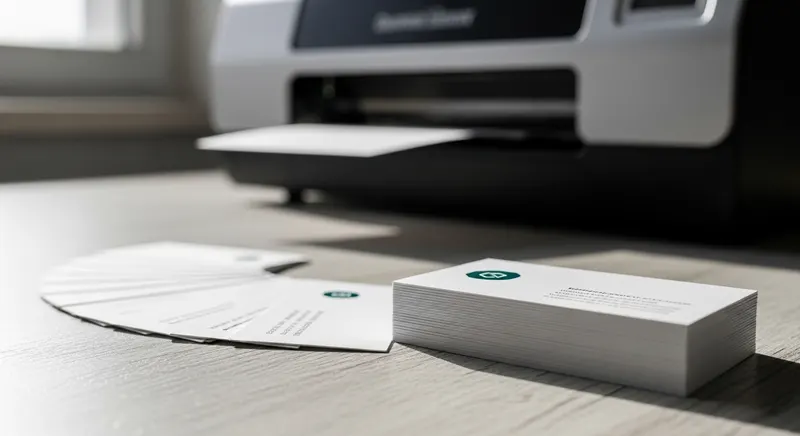
First impressions in business rarely get a second chance. Whether you’re handing over your details at a Sydney networking event, closing a deal in a Melbourne boardroom, or exhibiting at a Brisbane trade expo, a professionally printed business card speaks volumes before you’ve even said a word. Yet despite the digital age we live in, a surprisingly large number of Australian businesses still treat the print of business cards as an afterthought — and it shows. Flimsy stock, blurry logos, and incorrect colour matching can quietly undermine the credibility you’ve worked hard to build. This guide will walk you through everything you need to know to get your business cards printed right, from choosing the correct card stock and finish to understanding artwork requirements, turnaround times, and how to integrate your cards into a broader branded merchandise strategy.
Why the Print of Business Cards Still Matters in 2026
There’s a persistent myth that business cards are a relic of the pre-digital era. In reality, they remain one of the highest-return branded touchpoints available to any Australian business or professional. A well-designed, well-printed card is tactile, personal, and immediately memorable in a way that a LinkedIn profile or email signature simply cannot replicate.
Think about what happens during a conference, a real estate open inspection, or a trade show. Someone hands you a glossy, thick card with spot UV coating on the logo — it feels premium, and you associate that quality directly with the brand. Now contrast that with a thin, flimsy card printed on budget stock. The product being offered might be identical, but perception shapes decision-making.
For corporate teams, event organisers, and businesses across Australia, the print of business cards is also a brand consistency exercise. Your business cards should align visually with your other branded materials — from your custom branded tote bags to your personalised travel mugs and your team uniforms. Brand cohesion builds trust, and trust drives revenue.
What Types of Businesses Benefit Most from Premium Business Cards?
Virtually every sector benefits, but a few stand out as particularly high-stakes environments:
- Real estate agencies handing cards to vendors and buyers at inspections
- Corporate consultancies attending interstate or international client meetings
- Healthcare professionals distributing referral information to patients
- Event organisers connecting with venue managers, sponsors, and suppliers
- Creative agencies where the card itself is a canvas for demonstrating design capability
Understanding Card Stock and Finish Options
One of the most important decisions in any print of business cards project is the stock weight and surface finish. This is where many organisations underestimate the impact on the final product.
Card Stock Weight
Card stock is measured in GSM (grams per square metre). For business cards, common weights include:
- 300 GSM — the entry-level standard, adequate for budget print runs
- 350–400 GSM — the most popular range for professional cards, offering a satisfying thickness and rigidity
- 450–600 GSM — premium territory, often used for luxury brands, senior executives, or creative professionals
Going too light makes a card feel insubstantial. If you’re investing in high-quality branding across your organisation — perhaps alongside custom work polo shirts for your team or unique corporate gifts for clients — it makes little sense to scrimp on card stock.
Surface Finishes
The finish you choose dramatically affects both appearance and durability:
- Matte lamination — a smooth, non-reflective surface that photographs well and feels sophisticated. Popular with law firms, accountants, and consultancies.
- Gloss lamination — high shine, vibrant colour reproduction. Works well for photography-heavy cards or bright brand colours.
- Soft-touch lamination — a velvety, tactile finish that feels luxurious. Increasingly popular in 2026 for premium corporate use.
- Spot UV coating — a gloss varnish applied selectively over specific elements (logos, text) on a matte base. Creates dramatic contrast and a high-end look.
- Uncoated stock — raw, paper-feel finish. Works well for organic brands, eco-conscious businesses, or those who want customers to write on the card.
For organisations with sustainability goals, uncoated recycled card stock is worth considering — it aligns nicely with broader commitments to sustainable promotional products.
Artwork Requirements for a Flawless Print of Business Cards
Submitting artwork correctly is one of the most common pain points in any print of business cards order. Getting this wrong can delay your job, increase costs, or result in a finished product that doesn’t match your expectations.
Resolution and File Format
Business card artwork should be supplied at a minimum of 300 DPI (dots per inch) at actual print size. Screen resolution (72 DPI) will appear sharp on a monitor but will print blurry. The most reliable file formats are:
- PDF (print-ready, with bleed and crop marks)
- AI (Adobe Illustrator native file)
- EPS (vector, preferred for logos)
Avoid supplying JPEG or PNG files unless they’ve been confirmed as 300 DPI or higher at the final card dimensions.
Bleed and Safe Zone
Standard business card dimensions in Australia are 90mm x 55mm, though 85mm x 55mm is also common. Your artwork should include:
- 3mm bleed on all sides — extends background colours or images beyond the trim line to prevent white edges after cutting
- 3–4mm safe zone inside the trim edge — keep all critical text and logos within this boundary
Colour Mode and PMS Matching
All print files should be set up in CMYK colour mode, not RGB. RGB is a screen colour space and will shift when converted to CMYK for printing, often producing unexpected colour changes — particularly in blues and purples.
If your brand has Pantone (PMS) colour specifications, discuss this with your printer. PMS matching is available through certain print methods but typically commands a premium. For most standard offset or digital print runs, your printer will convert PMS values to their closest CMYK equivalent, so always request a physical proof before approving a full run.
Decoration Methods Used in Business Card Printing
The print of business cards isn’t limited to a single technology. Different methods produce different aesthetic results and suit different budgets.
Digital Printing
The most common and cost-effective method for short-to-medium runs (50–1,000+ cards). Produces sharp, full-colour results. Turnaround is typically fast — often 3–5 business days for standard jobs.
Offset Lithographic Printing
Preferred for larger volume runs where colour accuracy and consistency across thousands of cards is essential. Setup costs are higher but per-unit cost drops significantly at volume. Ideal for large corporate teams or organisations across multiple states.
Foil Stamping
A metallic foil (gold, silver, rose gold, holographic) is heat-pressed onto the card surface. Adds a premium finish, particularly effective on matte laminated stock. Common for executive cards, high-end hospitality, and financial services.
Embossing and Debossing
Creates a raised (emboss) or recessed (deboss) impression in the card surface. Frequently combined with foil for a layered luxury effect. Works exceptionally well with logos or brand names.
Letterpress Printing
A traditional craft printing method where type or imagery is pressed into thick, uncoated card. Produces a distinctive tactile impression. Beloved by designers, architects, and creative businesses.
You can learn more about decoration technology options in our overview of UV printing technology for custom promotional merchandise.
Quantities, MOQs, and Budgeting
Minimum order quantities (MOQs) for business cards are generally low compared to other promotional products. Many Australian print suppliers offer runs starting from as few as 50 cards, though pricing per unit drops substantially at 250, 500, and 1,000 cards.
As a rough guide for 2026 pricing in Australia:
- 250 cards, standard gloss/matte, 350 GSM — approximately $40–$70
- 500 cards with soft-touch lamination — approximately $80–$140
- 500 cards with spot UV — approximately $120–$200
- Foil stamping or letterpress — significantly higher, often $200–$400+ for 250 cards, depending on complexity
Setup fees for bespoke finishing methods (foil, letterpress, embossing) can add $50–$150 to your order, so factor this into comparisons between suppliers.
Integrating Business Cards into a Broader Branded Merchandise Strategy
Business cards are rarely the only branded item an organisation orders. Smart businesses think about touchpoints holistically. When someone walks away from a meeting with your card, what else do they have that reinforces your brand?
At events and conferences, your card might be paired with a branded vinyl sticker on a conference satchel, or handed over alongside a custom water bottle. For corporate gift packs, cards often accompany items like personalised mugs or wine gift sets. The point is that business cards don’t live in isolation — they’re one element of a broader brand story.
If you’re based in regional New South Wales, check out our guide to branded merchandise for the Illawarra region for local-specific insights. And if your team attends outdoor or sporting events where brand visibility matters, it’s worth reading how custom t-shirts for sports and personalised water bottles can complement your in-person networking toolkit.
Tips for a Smooth Business Card Print Project
Before you place your order, run through this checklist:
- Confirm your brand colours in CMYK — don’t rely on your screen
- Supply files at 300 DPI or in vector format — request a high-res proof before approval
- Order a physical sample if you’re trying a new stock or finish for the first time
- Allow at least 5–7 business days for standard turnaround; more if foil or embossing is involved
- Order more than you think you need — per-card costs drop at higher quantities, and running out is more costly than having extras
- Check all text carefully — names, titles, phone numbers, email addresses, and URLs are common sources of error that a printer cannot catch for you
Conclusion
The print of business cards is one of the smallest investments an Australian business or professional can make — and one of the most impactful when done well. From selecting the right card stock and surface finish to supplying correctly formatted artwork and choosing the most suitable printing method, every decision contributes to how your brand is perceived the moment a card changes hands.
Key Takeaways
- Stock weight matters — 350–400 GSM is the sweet spot for professional business cards that feel substantial without excessive cost
- Choose your finish deliberately — matte, gloss, soft-touch, spot UV, and foil all send different brand signals
- Supply print-ready files in CMYK at 300 DPI — poor artwork is the number one cause of print delays and disappointing results
- Order at volume — pricing per card drops significantly at 250, 500, and 1,000 units
- Think holistically — your business card is one part of a broader branded experience that includes apparel, drinkware, bags, and other promotional merchandise